


I. Recommended Intake of DHA
    Infants and young children:                      100 mg/day
    Children and adolescents:          160-200 mg/day
    Pregnant and lactating women:   300 mg/day
    Adults:                           220 mg/day
Comprehensively referring to the recommended intake levels of DHA from various international authoritative institutions, including the World Health Organization (WHO), the International Society for the Study of Fatty Acids and Lipids (ISSFAL), the National Institutes of Health (NIH), the European Food Safety Authority (EFSA), the Dutch Health Council (DHC), the Japanese Ministry of Health, Labour and Welfare (MHLW), etc.
II. Sources of DHA
In daily diets, DHA mainly exists in seafood such as deep-sea fish. In addition, there is also a small amount of DHA in animal livers and egg yolks.
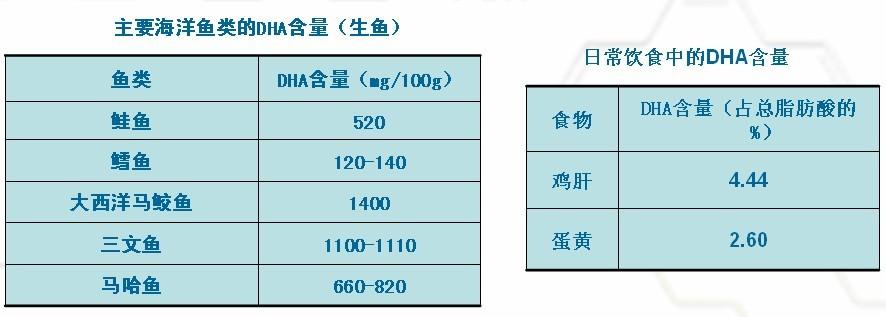
For healthy adults, the conversion rate of DHA in the human body is extremely low. Studies have shown that the conversion rate of linolenic acid to DHA in the body is less than 0.5%. In daily diets, ordinary meat, vegetables, and fruits do not contain DHA. Although animal livers and egg yolks contain small amounts of DHA, they cannot meet the daily intake requirement of DHA. Therefore, DHA is mainly supplemented by eating deep-sea fish. However, due to differences in geographical environments and eating habits, the vast majority of Chinese residents consume deep-sea fish products less frequently. Even residents in coastal areas find it difficult to ensure a certain amount of fresh sea fish intake every day. Developed countries maintain a relatively high level of DHA intake. For example, the daily DHA intake of Australian adults in 2009 was 200mg/day. In contrast, the daily DHA intake of Chinese residents is relatively low. According to a 2002 survey on dietary fatty acid intake of Chinese adults conducted by the Institute of Nutrition and Food Safety, Chinese Center for Disease Control and Prevention, the DHA intake of urban residents in China is 22.1mg/day, and that of rural residents is 6.0mg/day. Therefore, it is necessary for domestic residents to take additional DHA.
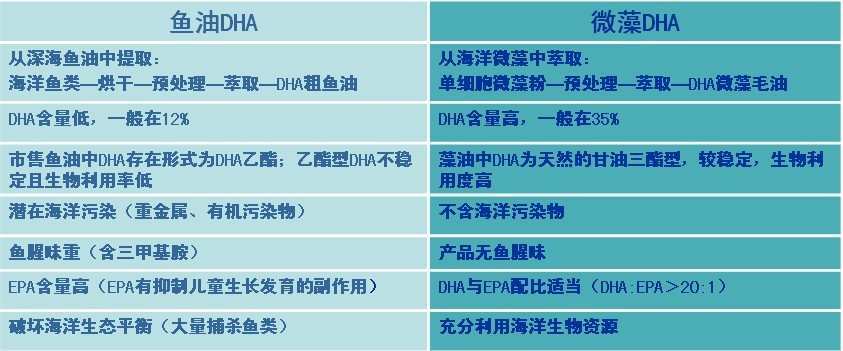
The difference between fish oil DHA and microalgae DHA:
III. Applications of DHA in International and Domestic Markets
DHA is mainly used in the health product and food industries. Among them, in the health product industry, it is mainly launched in the form of DHA soft capsules. In the food industry, DHA (mainly microalgal DHA) has a very wide range of applications. In the international market, DHA is added to granules, infant formula products (such as infant formula milk powder, milk substitutes, etc.), beverages (such as liquid milk, fruit juice, etc.), candies, bread, biscuits, ham sausages, cereal, etc. In addition, adding microalgal DHA to edible oil has become a new development trend. Internationally, there are already health-care edible oils (for direct oral administration) and ordinary edible oils (for cooking and boiling) with added DHA.
In the domestic market, as people’s awareness of DHA (especially microalgae DHA) continues to improve, the level of attention paid to DHA is also increasing. Currently, DHA in China is mainly used in infant formula products (such as milk powder, rice flour, etc.). There are also some products on the market that contain added DHA, such as granules, candies, and liquid milk. Recently, COFCO Group also launched “Fortune DHA Multi-Grain Edible Blend Oil”, which has become the only designated grain and oil product for the 2010 Shanghai World Expo.
With the mission of “extending human lifespan”, Runke Biology looks forward to cooperating with major enterprises in the health product, food and other industries to jointly promote the wide application of microalgae DHA in the Chinese market. While actively promoting human health, it will also bring considerable economic and social benefits to enterprises and society.


